
Table of Contents
- What Are Court-Mandated Anger Management Classes?
- How Long Are Court-Ordered Anger Management Classes?
- Finding Court-Approved Anger Management Providers
- Step-by-Step Process for Completing Your Court-Mandated Program
- What to Expect During Anger Management Sessions
- Legal Compliance and Documentation Requirements
- Conclusion
Last Updated: August 20, 2026
What Are Court-Mandated Anger Management Classes?
Court-mandated anger management classes are structured educational and therapeutic programs that individuals must complete as part of a court order, probation requirement, or sentencing condition. These programs teach participants evidence-based coping skills, emotional regulation techniques, and conflict resolution strategies to help them manage anger more effectively and reduce the risk of future behavioral incidents.
Court-mandated programs differ from voluntary counseling. A judge, probation officer, or court system orders attendance as a legal requirement. Failure to complete the program can result in additional legal consequences, including fines, extended probation, or incarceration.
According to research from GoodTherapy’s 2026 effectiveness analysis, cognitive-behavioral therapy (CBT) based anger management interventions show a 76% success rate in reducing aggressive behaviors. Most court-approved programs use CBT or similar evidence-based approaches. About 30% of adults report trouble controlling their anger, according to Anger Management ASB 2025 statistics, yet fewer than one in seven seek help. Court orders close that gap by making professional intervention mandatory.
AACS Counseling specializes in court-ordered and employment-related evaluations with 25 years of experience in alternative sentencing solutions. The practice uses evidence-based cognitive-behavioral interventions to help individuals navigate legal challenges and build lasting behavioral change. Same-day access to evaluation paperwork ensures clients meet tight court deadlines.
How Long Are Court-Ordered Anger Management Classes?
The duration of court-ordered anger management classes varies depending on the severity of the offense, the specific court order, and the program structure. Most court-mandated programs range from 8 hours to 12 weeks.
Intensive programs typically span 8 hours in a single day or across two consecutive days. These compressed formats work well for individuals with tight schedules or those who need rapid completion to meet court deadlines.
Weekly series programs usually run 8 to 12 weeks with sessions lasting 1.5 to 2 hours per week. This extended format allows participants to practice new skills between sessions and apply what they’ve learned to real-life situations. Research shows that spaced learning often produces stronger, more lasting behavioral change than compressed learning.
The specific duration your court order requires will be stated in your sentencing documents or probation agreement. Confirm the exact requirement with your probation officer or the court before enrolling, as completing the wrong program length could mean you haven’t satisfied your legal obligation.
Finding Court-Approved Anger Management Providers
Not all anger management classes are court-approved. A program must meet specific criteria, typically including certified instructors, evidence-based curriculum, and documentation standards, to be recognized by courts and probation departments.
How to verify court approval:
Start by contacting your local probation department or the court that issued your order. Ask for a list of court-approved anger management providers in your area. Your probation officer can also recommend specific providers they work with regularly.
Search online for providers that explicitly state "court-approved," "court-recognized," or "court-mandated anger management classes." However, verify this claim independently by calling your local probation office to confirm whether a specific program is genuinely recognized by the court system.
Look for programs that employ licensed clinicians, counselors, or psychologists. Court-approved programs typically require instructors to have formal training in anger management, behavioral modification, or mental health counseling. Instructors with credentials like Licensed Professional Counselor (LPC) or Licensed Clinical Social Worker (LCSW) are more likely to deliver evidence-based programming.
Check whether the provider offers same-day or rapid documentation. Courts and probation departments need proof of completion. Providers that can issue your certificate of completion immediately after the final session reduce delays and help you close out your legal obligation faster.
AACS Counseling provides court-approved anger management classes accepted by courts and probation departments. The practice delivers official completion documentation upon completion, which probation officers and employers recognize as evidence of program fulfillment.
Step-by-Step Process for Completing Your Court-Mandated Program
Completing a court-mandated anger management program requires following a structured process from enrollment through final documentation.
Step 1: Understand Your Court Order Requirements
Before enrolling in any program, you must fully understand what your court order requires. Your sentencing documents or probation agreement should specify the type of programming, minimum hours, and timeline for completion.
Obtain a copy of your court order or probation agreement. Read it carefully and highlight the specific requirements. Look for:
- The exact number of hours or sessions required
- The deadline for completion
- Whether the program must be court-approved or court-recognized
- Any restrictions on program type (e.g., in-person vs. online)
- Whether you need a specific certificate or documentation format
Contact your probation officer and ask them to clarify anything unclear. Probation officers work with anger management providers regularly and can answer questions about which programs meet your specific order.
Step 2: Schedule Your Initial Assessment
Most court-approved anger management programs begin with an initial assessment or intake session. This session allows the provider to understand your background, the circumstances that led to the court order, and any co-occurring mental health or substance abuse issues that might affect your treatment.
Call your chosen provider and explain that you have a court order for anger management. Ask about available appointment times, what documentation you need to bring, whether the initial assessment counts toward your required hours, and how long the assessment typically takes.
Be honest during your assessment. Providers need accurate information to recommend the right program intensity and curriculum. After the assessment, the provider will confirm your program start date and explain the schedule, location, and what to expect during sessions.
Step 3: Attend Your Facilitated Sessions
Attendance is non-negotiable. Missing sessions can result in probation violations, fines, or additional legal consequences. Mark your calendar and treat anger management classes with the same priority as work or school.
During sessions, actively participate. Anger management classes use discussion, role-playing, and group activities to teach skills. Take notes during sessions and write down the specific techniques discussed, coping strategies, and trigger-management approaches. If you’re struggling with the material or have questions, speak up during or after class.
Step 4: Obtain Your Anger Management Certificate of Completion
Upon completing all required sessions, your provider will issue a certificate of completion. This document is your proof that you’ve fulfilled the anger management requirement of your court order. Providers typically issue certificates immediately after the final session or within 1-2 business days.
Your certificate should include your full name and date of birth, the program name and provider name, the dates you attended, total hours completed, a statement that you completed the program, the instructor’s or provider’s signature and credentials, and contact information for verification.
Request multiple copies of your certificate. Submit one to your probation officer immediately. Don’t wait. Prompt submission shows you’re taking your legal obligations seriously and closes out this requirement faster.
What to Expect During Anger Management Sessions
Understanding what happens during anger management sessions reduces anxiety and helps you prepare mentally for the experience.

Sessions typically begin with a check-in where the instructor asks participants about their week, any anger incidents they experienced, and what triggered those moments. The instructor then introduces or reviews a specific anger management technique. Common topics include identifying anger triggers, understanding the physical signs of escalating anger, practicing deep breathing or progressive muscle relaxation, developing assertive communication skills, and problem-solving approaches to conflict.
Interactive practice is a major component. You’ll participate in role-plays where you practice responding to common anger-triggering situations. Group discussion is another key element. You’ll hear from other participants about their anger triggers and how they’re applying new skills. Sessions close with homework or practice assignments where you might track your anger triggers for a week or practice a specific breathing technique daily.
Most participants feel defensive or skeptical in early sessions. That’s normal. Give yourself at least three sessions before deciding whether the program is working. Many people report that the real value emerges once they start practicing the techniques outside of class.
Legal Compliance and Documentation Requirements
Completing an anger management program is only half the battle. Ensuring your completion is properly documented and reported to the court is equally critical.
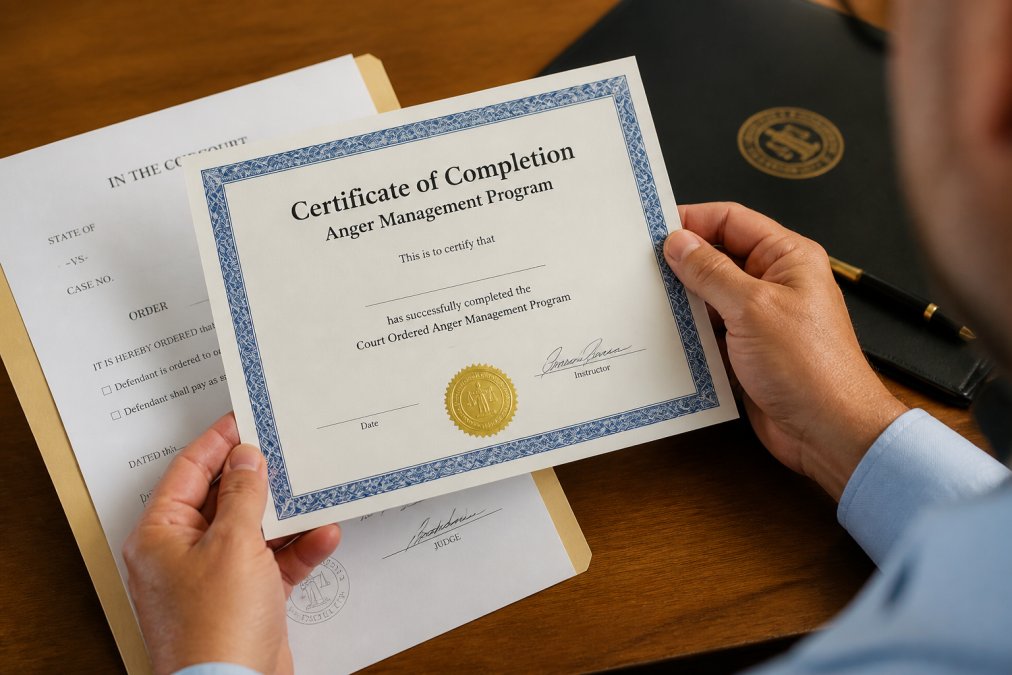
Your provider must issue a certificate of completion that meets court standards. The certificate should state the program name, dates attended, total hours completed, and the instructor’s credentials and signature. Some courts have specific formatting requirements or required language. Ask your provider whether they’re familiar with your specific court’s documentation standards.
Submit your certificate to your probation officer within one week of program completion. Most providers give you the certificate and expect you to handle submission. Keep a copy for your records and request written confirmation from your probation officer that they received it.
For employment-related anger management, you’ll typically submit your certificate directly to your HR department or the employee assistance program (EAP) coordinator. Keep a personal copy as well.
Document retention matters. Save your certificate, attendance records, and any completion letters for at least five years. Some professional licenses, housing applications, or future legal proceedings may require proof that you completed court-ordered anger management.
If your provider loses your certificate or can’t locate your attendance records, you could face significant problems proving completion to your probation officer or employer. Choose a provider with a strong reputation for maintaining records and issuing timely documentation. AACS Counseling’s commitment to same-day documentation ensures you leave with proof of completion in hand.
| Requirement | What It Means | Why It Matters |
|---|---|---|
| Court-approved provider | Instructor and curriculum meet court standards | Ensures your completion will be accepted by the court |
| Certificate of completion | Official documentation of program completion | Proof for probation officer, employer, or court |
| Attendance verification | Record of every session you attended | Confirms you met the required hours |
| Instructor credentials | Licensed counselor, clinician, or psychologist | Ensures quality instruction and program legitimacy |
| Timely submission | Certificate delivered to probation within 1 week | Prevents probation violations and delays |
Court-mandated anger management classes represent a significant opportunity. The research is clear: participants in anger management programs report a 50-70% reduction in anger outbursts, and those completing cognitive-behavioral treatment see meaningful improvements in emotional regulation and conflict resolution. Completing your program closes out a legal obligation and gives you tools that work in real life.
The process from court order to certificate of completion is straightforward when you understand each step. Verify your court’s requirements, enroll in a court-approved program, attend consistently, and ensure your completion is properly documented. AACS Counseling specializes in court-mandated anger management with 25 years of experience, evidence-based cognitive-behavioral interventions, and same-day completion documentation. Get a free quotation today and take the first step toward fulfilling your legal obligation and building lasting behavioral change.
Frequently Asked Questions
What are court-ordered anger management classes?
Court-ordered anger management classes are educational and therapeutic programs mandated by the judicial system for individuals convicted of anger-related offenses or behavioral issues. These classes teach coping skills, emotional regulation, and conflict resolution techniques through facilitated sessions led by certified specialists. About 30% of adults report trouble controlling their anger, yet fewer than 13% seek help. Court-mandated programs provide structured intervention with accountability, helping participants develop strategies to manage impulses and prevent future incidents.
How long are court-ordered anger management classes?
Court-ordered anger management classes vary in duration depending on your specific court order and the program you choose. Many providers offer intensive 8-hour classes completed in one or two days, while others provide multi-week series spanning 4 to 12 weeks with weekly sessions. The length also depends on whether you require basic anger management or a more comprehensive behavioral modification program. Your court order will specify the exact hours or sessions required. Always verify the specific duration with your treatment provider and court to ensure compliance.
How do I find court-approved anger management providers?
To find court-approved anger management providers, start by checking your court order for any recommended or approved providers. Contact your probation officer or the court clerk for a list of state-recognized treatment providers in your area. You can also search online for 'court-approved anger management providers' combined with your location. Verify that any provider is certified to deliver court-mandated curriculum and can issue official completion documentation accepted by your court. Ask about their credentials, experience with court-mandated clients, and whether they offer flexible scheduling for working individuals.
What happens if I don't complete my court-ordered anger management?
Failing to complete court-mandated anger management can result in serious legal consequences, including probation violations, increased fines, extended probation periods, or additional jail time. Non-compliance is reported to the court and can negatively affect custody arrangements, employment, or licensing. If you're struggling to complete your program due to scheduling, cost, or other barriers, contact your treatment provider and probation officer immediately to discuss alternatives or extensions. Many programs work with clients to find solutions rather than report non-compliance, especially if you communicate early.
This article was written using GrandRanker