
Table of Contents
- What Is a DOT SAP Evaluation?
- Who Must Undergo a DOT SAP Evaluation?
- Understanding the DOT SAP Return-to-Duty Process
- How Long Does SAP Evaluation Take?
- What to Expect During a SAP Evaluation
- SAP Qualification Requirements and Credentials
- Cost, Follow-Up Testing, and Employer Responsibilities
- Common Myths About DOT SAP Evaluations
Last Updated: August 22, 2026
What Is a DOT SAP Evaluation?
A Substance Abuse Professional (SAP) evaluation is a clinical assessment required by the Department of Transportation for commercial drivers who violate federal drug and alcohol testing regulations. It’s a comprehensive conversation between you and a qualified clinician designed to determine whether you have a substance abuse disorder and what treatment or education you need before returning to safety-sensitive work.
The evaluation involves no specimen collection. Instead, a DOT-qualified SAP uses standardized assessment tools, reviews your history, and conducts a face-to-face interview to understand your situation. According to [The 2026 State of the DOT SAP Return-to-Duty Process(/how-to-complete-dot-sap-evaluation-fast/) by American River Wellness | americanriverwellness.com], 67.9% of drivers began this process understanding only some of it or none at all. The purpose is straightforward: to protect public safety while giving you a documented path back to work. The SAP’s job is to assess your situation honestly and recommend the next steps, which may be education, treatment, or both.
Who Must Undergo a DOT SAP Evaluation?
Any commercial driver who violates the DOT drug and alcohol testing program must undergo a SAP evaluation. This includes drivers holding a Commercial Driver’s License (CDL) in safety-sensitive positions, as well as other DOT-regulated employees in transportation, pipeline operations, and hazmat roles.
You’re required to see a SAP if you:
- Test positive for drugs or alcohol in a DOT-regulated test
- Refuse to submit to a required test
- Fail to appear for a scheduled test
- Tamper with or adulterate a specimen
- Violate the DOT testing rules in any other documented way
According to American River Wellness 2026 survey data, random testing accounts for 43.4% of violations, followed by pre-employment testing at 18.9%. Marijuana or THC involvement appeared in almost half of all violations (49.1%), making it by far the most common substance cited.
Your employer is required to notify you of the violation and refer you to a SAP. You cannot skip this step, and your employer cannot waive it. However, you do have the right to select your own SAP from a list of qualified professionals. The key requirement is that the SAP must be qualified under 49 CFR Part 40, which means holding specific credentials in substance abuse counseling or a related field.
Understanding the DOT SAP Return-to-Duty Process
The return-to-duty process is a structured pathway with clear steps, timelines, and documentation requirements.
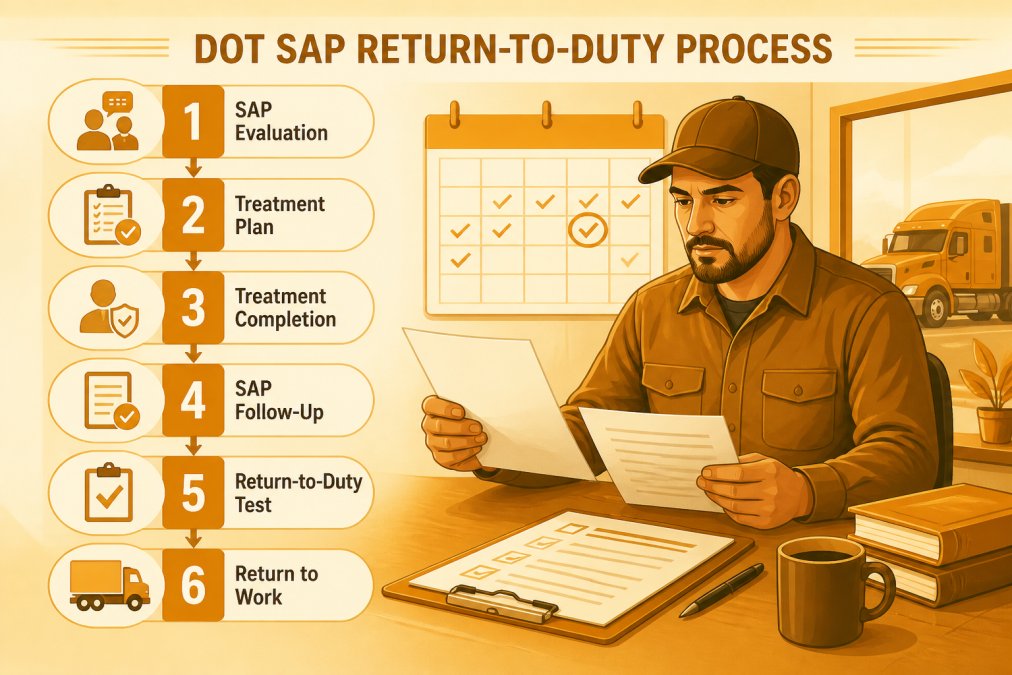
Step 1: The Initial SAP Evaluation
You’ll meet with a qualified SAP for a clinical interview covering your substance use history, medical background, psychological factors, and lifestyle. The SAP will use standardized assessment tools to evaluate whether you have a substance abuse disorder. According to the 2026 data, 49.1% of drivers had their first SAP evaluation within two weeks of their violation.
Step 2: The SAP’s Recommendation
After the evaluation, the SAP will recommend education only, treatment only, or a combination of both. This recommendation is documented and submitted to your employer and the FMCSA Clearinghouse. You cannot seek a second SAP if you disagree with the first one; 49 CFR §40.295 explicitly prohibits this.
Step 3: Completing Education and/or Treatment
If education is recommended, you’ll attend substance abuse education classes, typically 4-8 hours of instruction. If treatment is recommended, you may enter an outpatient program, intensive outpatient program, or inpatient treatment depending on severity. You must complete whatever the SAP recommends before moving forward.
Step 4: The Final SAP Evaluation
Once you’ve completed the education or treatment plan, you return to the SAP for a final evaluation. The SAP will assess your progress and determine whether you’re fit to return to duty.
Step 5: Negative Return-to-Duty Test
Before you can return to work, you must pass a negative drug and alcohol test at a certified testing facility.
Step 6: Follow-Up Testing Agreement
You’ll be subject to unannounced testing for 12 months following your return to duty, with a minimum frequency set by the SAP (typically 6-12 unannounced tests during that year).
How Long Does SAP Evaluation Take?
The total timeline depends on the SAP’s recommendation, but most drivers complete the return-to-duty process in 60 to 90 days. The initial evaluation appointment itself is usually 1 to 2 hours long.
After the initial evaluation, the timeline extends based on the SAP’s recommendation. If education only is recommended, that’s typically 4-8 hours of classes, which can be completed in 1 to 4 weeks depending on scheduling. If treatment is recommended, the duration varies from 4 weeks for an intensive outpatient program to several months for more comprehensive treatment.
According to the 2026 American River Wellness survey, 69.8% of drivers lost more than $3,000 while off the road due to a DOT violation (americanriverwellness.com). This is why getting scheduled quickly matters.
Request your SAP appointment immediately after your violation is documented. The sooner you start, the sooner you complete the process.
What to Expect During a SAP Evaluation
The SAP evaluation is a clinical conversation, not an interrogation. You’ll sit down with a qualified substance abuse professional in a private, confidential setting to discuss your substance use history, current situation, and circumstances around the violation.

The Interview Process
The SAP will ask detailed questions about your substance use history, medical history, mental health, family history of substance abuse, and current life circumstances. They’ll discuss the specific violation and what led to it. This isn’t about judgment; the SAP’s role is to gather clinical information to make an accurate assessment. You should be honest. The conversation is confidential, protected by federal privacy laws.
Standardized Assessment Tools
The SAP will use validated assessment instruments and structured tools to evaluate your risk level and the severity of any substance abuse issues.
No Drug Testing
The SAP evaluation does not include drug or alcohol testing. The evaluation is purely clinical assessment.
Documentation
The SAP will document the evaluation thoroughly and provide you with a copy of the assessment and recommendations. This documentation goes to your employer and the FMCSA Clearinghouse.
The SAP evaluation is a conversation designed to assess whether you have a substance abuse disorder and what support you need. It’s clinical, confidential, and focused on getting you back to work safely.
SAP Qualification Requirements and Credentials
Not every counselor or therapist can be a DOT SAP. The Department of Transportation has specific credential requirements to ensure that evaluations are conducted by qualified professionals with expertise in substance abuse assessment and treatment.
A qualified SAP must hold at least one of the following credentials:
- Licensed physician (MD or DO) with knowledge of substance abuse disorders
- Licensed or certified psychologist with training in substance abuse
- Licensed or certified social worker with substance abuse specialization
- Licensed professional counselor (LPC) with substance abuse certification
- Certified addiction counselor (CAC) or certified substance abuse counselor (CSAC)
- Other state-licensed healthcare professional with documented training in substance abuse assessment
The SAP must also complete DOT-specific training on the return-to-duty process, Part 40 regulations, and the SAP’s role and responsibilities. This training is typically 8-16 hours and must be completed before the SAP can conduct evaluations.
Be cautious of SAP providers who cannot clearly document their credentials or who seem to rush evaluations. A thorough SAP evaluation requires time and clinical expertise.
Cost, Follow-Up Testing, and Employer Responsibilities
The financial reality of a DOT SAP evaluation extends far beyond the evaluation fee itself.
SAP Evaluation Costs
The SAP evaluation fee varies by provider and geographic location. According to the 2026 American River Wellness survey, 28.3% of drivers paid $451 to $600 just for the SAP evaluation. Pricing depends on the provider’s location, credentials, and whether the evaluation is conducted in person or via telehealth.
Treatment and Education Costs
If the SAP recommends education, costs typically range from $300 to $1,000 depending on the provider and format. Treatment programs vary widely based on intensity and duration, from outpatient programs at $500 to $2,000 per month to intensive inpatient programs at significantly higher costs.
Return-to-Duty Testing
After you complete the SAP’s recommendations, you must pass a negative return-to-duty test at a certified lab, costing $50 to $150.
Follow-Up Testing
Once you return to duty, you’re subject to unannounced follow-up testing for 12 months. Each test costs $50 to $150.
Employer Responsibilities
Your employer must:
- Notify you of the violation and refer you to a qualified SAP
- Allow you reasonable time off to complete the SAP evaluation and any recommended treatment
- Not permit you to perform safety-sensitive duties until you’ve completed the return-to-duty process and passed the return-to-duty test
- Ensure follow-up testing is conducted as agreed
- Report the violation to the FMCSA Clearinghouse
Employers must also maintain accurate records of your testing history and SAP evaluation results.
Drivers facing tight deadlines who need rapid scheduling and same-day documentation to minimize time off the road.
Common Myths About DOT SAP Evaluations
Misconceptions about the SAP evaluation process create unnecessary anxiety.
Myth 1: A SAP Evaluation Automatically Means Job Loss
False. The DOT return-to-duty process exists specifically to help employees return to safety-sensitive work. Many individuals return to the same employer or find new employment after completing the process.
Myth 2: The SAP Evaluation Is Just Another Drug Test
False. The SAP evaluation is a clinical conversation and assessment, not a drug test. No specimen collection occurs during the SAP appointment. The drug test (return-to-duty test) comes after the SAP clears you.
Myth 3: You Can Get a Second SAP Evaluation if You Disagree with the First
False. According to 49 CFR §40.295, an employee who has been evaluated by a SAP cannot seek a second SAP evaluation to obtain a different recommendation.
Myth 4: The SAP Evaluation Will Definitely Recommend Treatment
Not necessarily. The SAP’s recommendation depends on the clinical assessment. If the SAP determines you don’t have a substance abuse disorder, education only may be recommended.
Myth 5: You’ll Lose Your CDL Permanently
False. A DOT violation doesn’t automatically result in permanent license revocation. The return-to-duty process is designed to allow you to regain your commercial driving privileges after completing the required steps.
Myth 6: Telehealth SAP Evaluations Aren’t Legitimate
False. Telehealth SAP evaluations are fully allowed by DOT as long as the evaluator is DOT-qualified and the evaluation is conducted with real-time two-way audio and visual communication.
The DOT SAP evaluation process is designed to protect public safety while giving you a clear, documented path back to work. Understanding what it is, what to expect, and how to navigate it removes much of the uncertainty that makes the process feel overwhelming. The key is starting quickly, being honest with your SAP, and completing whatever they recommend. At AACS Counseling, we’ve helped hundreds of drivers through this process with same-day documentation and DOT Clearinghouse reporting, ensuring you meet your deadline and get back on the road. Get a free quotation today to understand your costs and timeline.
| Step | Duration | Key Requirement |
|---|---|---|
| Initial SAP Evaluation | 1-2 hours | Schedule within days of violation |
| Education/Treatment | 1-12 weeks | Complete SAP’s recommendation |
| Final SAP Evaluation | 1-2 hours | SAP clearance to proceed |
| Return-to-Duty Test | 1 day | Negative result required |
| Follow-Up Testing | 12 months | Minimum 6 unannounced tests |
Frequently Asked Questions
What are the current DOT SAP evaluation requirements for 2026?
The DOT SAP evaluation requirements for 2026 mandate that any DOT-regulated employee who violates substance abuse regulations must be evaluated by a qualified Substance Abuse Professional. The evaluation assesses the employee's substance abuse disorder, recommends education or treatment, and establishes a follow-up testing plan. All SAPs must hold appropriate credentials and comply with 49 CFR Part 40. The FMCSA Clearinghouse now requires faster reporting of violations and SAP progress, with penalties for delays. Virtual evaluations are fully allowed if conducted with real-time two-way audio and visual communication through a DOT-qualified evaluator.
How long does a DOT SAP evaluation take from start to finish?
The initial SAP evaluation appointment typically lasts 1 to 2 hours, though this varies based on individual circumstances. According to a 2026 survey of 1,060 CDL holders, 49.1% of drivers had their first SAP evaluation within two weeks of their violation, with 24.5% seen within 8 to 14 days. After the evaluation, the SAP provides recommendations for education or treatment. The total return-to-duty process, including treatment completion and follow-up testing, typically spans several months depending on the SAP's recommendations and the employee's compliance.
What happens if I fail a DOT drug test in 2026?
If you fail a DOT drug test, your employer must remove you from safety-sensitive duties immediately and refer you to a qualified SAP. A 2026 survey found that marijuana or THC was involved in 49.1% of all violations, making it the most common substance. You cannot return to safety-sensitive work until you complete the SAP evaluation, follow all recommendations, pass a return-to-duty drug test, and complete the required follow-up testing schedule. The process is designed to help you return to duty, not to end your career, many drivers successfully complete the process and resume their positions.
Can I choose my own SAP for a DOT violation?
You have the right to choose your SAP from a list of qualified professionals in your area, but the SAP must meet DOT credential requirements and cannot be someone with a conflict of interest (such as your employer or a family member). Once you have been evaluated by a SAP, DOT regulations (49 CFR §40.295) explicitly prohibit seeking a second SAP evaluation to obtain a different recommendation. Similarly, your employer cannot request a second evaluation if you have already been assessed by a qualified SAP. This rule ensures consistency and integrity in the return-to-duty process.
What is the role of the Substance Abuse Professional in the return-to-duty process?
The SAP conducts a clinical evaluation to assess whether you have a substance abuse disorder, recommends appropriate education or treatment, and establishes a follow-up testing schedule. The SAP does not conduct drug testing during the evaluation, that occurs separately. The SAP's role is to diagnose, recommend, and clear you for return to duty once you have completed the recommended plan. A qualified SAP must hold appropriate professional credentials, continuing education units, and DOT-specific training. The SAP's recommendations are binding; employers and employees must follow them to comply with federal regulations.
What should I expect during a SAP evaluation appointment?
During a SAP evaluation, you will meet with a qualified professional in a confidential setting for 1 to 2 hours. The evaluation involves conversation and history-gathering about your substance use, medical history, and personal circumstances. The SAP uses standardized assessment tools to evaluate your situation comprehensively. No drug or alcohol testing occurs during the SAP appointment itself, that is handled separately. After the evaluation, the SAP will provide recommendations for education, treatment, or both, and establish a follow-up testing plan. You will receive documentation of the evaluation and recommendations, which your employer submits to the FMCSA Clearinghouse.
How much does a DOT SAP evaluation cost in 2026?
A 2026 survey found that 28.3% of drivers paid $451 to $600 for the SAP evaluation alone, with 61.3% of drivers spending more than $450 overall. However, the total financial impact extends beyond the evaluation fee. The same survey showed that 69.8% of drivers lost more than $3,000 in income while off the road due to a DOT violation, and 61.3% went into debt to cover costs. The evaluation fee is only part of the expense; treatment, follow-up testing, and lost work time represent the larger financial burden. Contact a qualified SAP provider for current pricing and to discuss your specific situation.
This article was written using GrandRanker